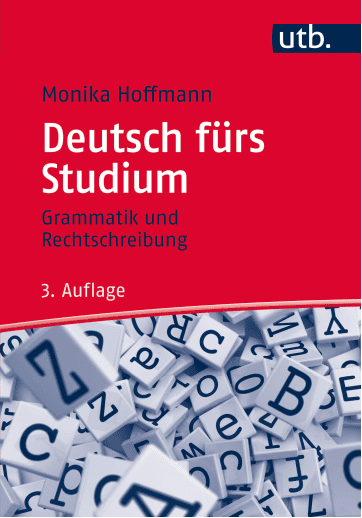
About This Book
Deutsch fürs Studium Grammatik und Rechtschreibung is a German book for the transition into university: grammar and spelling treated at the standard academic writing requires. Its title’s modesty is precise — it does not promise literature, conversation or culture; it promises the two competences every faculty silently grades in every submitted page, the sentence correctly built and the word correctly spelled, in the register where a student’s thinking is made visible and judged.
The need it serves is a specific, under-discussed gap. School German prepares learners to communicate; university German requires them to demonstrate — in prose whose surface errors are read, unfairly but universally, as errors of thought. Grammar at this level is no longer about dialogues surviving but about subordination, nominal style and punctuation carrying complex argument; spelling is no longer a schoolroom virtue but a professional credential, the academy’s first test of whether a writer can be trusted with difficult material.
What Learners Will Practise
Academic Sentence Architecture
Students practise the grammar of written argument: the extended sentence with its clauses properly subordinated, the verb bracket held across long distances, punctuation deployed as logic rather than decoration. The practice differs from school grammar in its material — the sentences of essays and analyses, where a misplaced clause does not merely err but misleads a reader following an argument.
Orthography at the Codified Standard
The book trains spelling as the academy audits it: the codified forms, the capitalisation system that German makes so visible, the comma rules whose mastery separates the careful writer from the lucky one. Practised to automaticity, orthography stops consuming the writer’s attention — which is the point: every unit of care freed from spelling is a unit available for the argument itself.
Register: From Classroom to Seminar
Students practise recognising and producing the academic register: precise where conversation is approximate, nominal where speech is verbal, impersonal where the essay must not chatter. The training is one of ear as much as rule — learning to hear when a sentence sounds like a student who will be taken seriously, and when it still sounds like the schoolyard wearing a tie.
Key Features
The study-specific aim is the feature: grammar and spelling selected and pitched for university use rather than general learning. The twin coverage is the second — syntax and orthography in one volume, the whole audited surface — and the adult standard the third, no schoolroom mercy assumed or offered. In this collection it is the German shelf’s finishing gate: beyond it, the language stops being studied and starts being wielded.
Who This Book Is For
Students entering German-medium university study are its first readers — the school-leavers whose German must convert, quickly, from spoken serviceability to written credibility. Advanced school pupils aiming at that transition form its second readership, building the academic surface before the first essay deadline builds it for them. Writers of theses and academic texts make its third: for them it is the audit manual kept beside the draft, the standard against which a page is checked before a supervisor checks it.
How to Use This Book
Work from your own writing: take a page of your current essay, audit it against the book’s grammar and spelling, and let your real errors choose the order of study. Drill spelling weak points as lists until they are reflexes — orthography practised in the abstract returns in the draft. And before any submission, run the final page through the book’s twin check deliberately: once for the sentences, once for the words, because the reader’s trust is won or lost on exactly those two passes.
Related Books
The science beneath its sentences is sounded out in Theoretische Phonetik der deutschen Sprache, and the self-checking grammar that underpins it stands at Deutsche Grammatik. mit Lösungen.