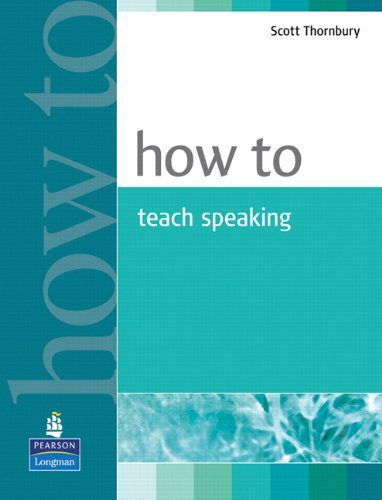
About This Book
How To Teach Speaking Book is a teacher-training book about teaching speaking — the skills volume devoted to oral work in the English classroom. Its served file carries the subject’s short name, ‘How to Teach Speaking’. Of the four skills, speaking is the one learners most want and classrooms least deliver, and the book exists in that gap: a practical treatment of how spoken fluency is actually built, lesson by lesson, by teachers who understand what talk needs in order to happen.
Its first subject is design. Speaking activities fail predictably — instructions that take longer than the activity, tasks completable in silence, groups in which one voice does the work of four — and each failure has a structural cure the book can teach: information gaps that make talk necessary, roles that distribute it, rehearsal stages that make public performance survivable. Its second subject is the teacher’s behaviour during talk: monitoring without interrupting, feeding language in at the moment of need, and operating the delayed-correction economy in which errors are noted during fluency work and treated afterwards. Its third is confidence, treated not as a personality trait but as an outcome of sequencing — private rehearsal before pairs, pairs before groups, groups before the whole room — so that no learner is asked to perform beyond their preparation. Pronunciation in speaking is handled as intelligibility rather than accent, and assessment as the fair measurement of a performance skill. A teacher who absorbs this book stops asking a class to ‘discuss’ and starts engineering the conditions under which discussion is the easiest thing in the room to do.
What Learners Will Practise
Designing Speaking Activities
Teachers practise constructing tasks in which talk is unavoidable: gaps to close, decisions to reach, problems only language can solve. The activity-design discipline — aim, staging, grouping, timing — is trained until a speaking lesson can be built from any topic in minutes.
Managing Talk in Class
The book practises the live management of speaking: setting up quickly, monitoring with a notebook rather than a red pen, joining groups as a resource instead of an audience, and ending activities at the peak rather than the fade. Classroom noise is reframed as evidence of work, and the teacher’s ear as its quality control.
Correcting Speech Without Silencing It
Teachers practise the speaking teacher’s signature judgement: errors harvested silently during fluency, treated in a feedback stage where the class repairs anonymised sentences together. The learner’s willingness to speak — the raw material of the entire skill — is protected as deliberately as accuracy is pursued.
Key Features
The activity-design method is the feature: speaking tasks engineered so that talk is the means, not the decoration. The delayed-correction economy is the second — fluency and accuracy given separate, protected stages — and the confidence-by-sequencing principle the third, a humane technology for quiet classrooms. In this collection it stands beside the general craft volume on the teacher-training shelf.
Who This Book Is For
Teachers whose speaking lessons under-deliver are its first audience, trainees and veterans alike. Teacher trainers form its second readership, observing speaking classes against its framework. Course planners make its third, building syllabuses in which oral work is the spine rather than the garnish.
How to Use This Book
Take one technique per week into a real class and judge it by a single measure: minutes of learner talk produced. Rehearsal stages will feel slow until the first discussion runs itself; persist. Trainers: observe a speaking lesson with this book’s staging in hand, and let the feedback conversation begin from the design rather than the teacher’s personality.
Related Books
The teacher-training shelf’s general craft volume stands at How To Teach English Book, and the teacher’s-book shelf’s Book 1 waits at Incredible English Teacher’s Book 1.